Internal business applications — CRMs, ERPs, HR systems, planning tools — have barely evolved in 20 years. They moved to the browser, but the underlying interaction model stayed the same: polling, refreshing, waiting, and guessing.
Meanwhile, modern companies expect software to behave like people:
- Always present
- Always aware
- Always responsive
- Always connected
This is exactly where workflows + Server-Sent Events (SSE) change the game.
Not because they make apps "realtime", but because they make apps connected.
Xelflow is built around this principle.
1. Internal systems don't need "realtime" — they need "connected users"
Most blogs talk about SSE for live dashboards or chat apps.
But inside companies, the real value is different:
Connected users = operational awareness
A connected user is one the system can see:
- The user is online
- The user is active
- The user is viewing record X
- The user is editing workflow step Y
- The user is waiting for approval Z
This awareness unlocks business capabilities that traditional web apps simply cannot deliver.
Why this matters for CRMs and ERPs
Internal systems depend on coordination:
- Two agents editing the same customer file
- A manager approving a workflow step
- A warehouse operator updating inventory
- A finance employee processing invoices
These are not "realtime events".
They are collaboration events.
SSE is the perfect protocol for this.
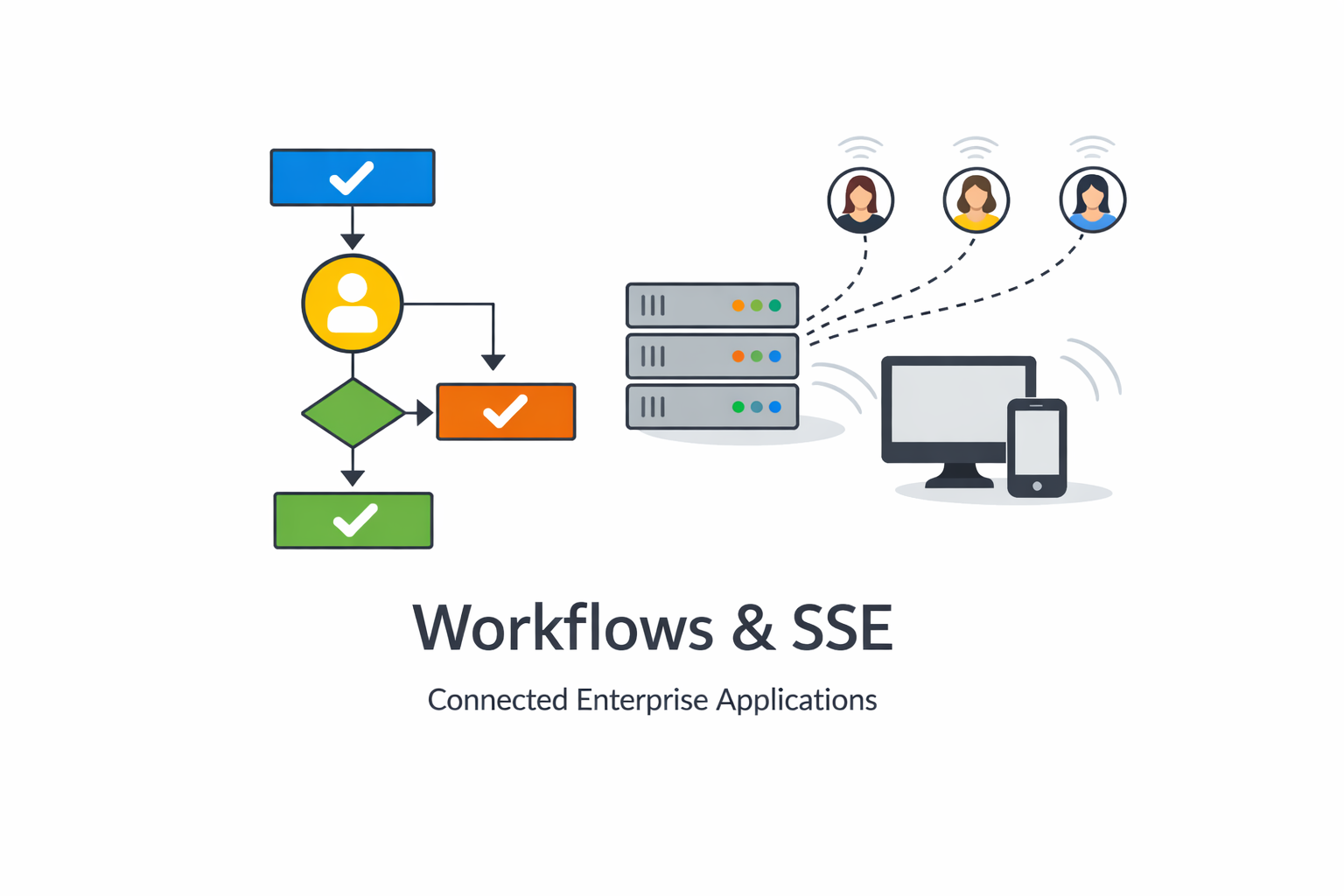
2. Workflows define the business logic — SSE keeps everyone in sync
Workflows describe how the business operates:
- Who does what
- In which order
- Under which conditions
- With which data
- Triggered by which events
But workflows alone are not enough.
They need live connectivity to users.
SSE provides the missing link
With SSE, the workflow engine can:
- Push updates to users instantly
- Notify users when their step is ready
- Lock/unlock records based on presence
- Update UI components without reload
- Coordinate multiple users in the same process
- Keep long-running tasks visible and trackable
This transforms workflows from static definitions into living processes.
3. Why SSE is ideal for internal enterprise environments
A. Works flawlessly behind corporate firewalls
SSE uses plain HTTP.
No WebSocket upgrades.
No special ports.
No exotic infrastructure.
IT departments love this.
B. Predictable, stable, low-maintenance
SSE connections:
- Auto-reconnect
- Are easy to scale
- Are easy to monitor
- Are easy to secure
- Behave consistently across browsers
This makes SSE perfect for long-lived enterprise sessions.
C. Designed for event-driven business logic
Internal systems don't stream thousands of messages per second.
They emit discrete workflow events:
- "Approval completed"
- "Record updated"
- "Task assigned"
- "Import finished"
- "User joined the process"
SSE is built for exactly this pattern.
4. The business impact: faster operations, fewer mistakes, happier users
A. No more "refresh to see updates"
Users see workflow changes instantly.
This reduces friction and speeds up processes.
B. No more double-editing or overwriting
Presence awareness prevents conflicts:
- "This record is currently edited by Sarah."
- "You are in read-only mode."
This saves time and eliminates errors.
C. No more polling or waiting
Instead of checking "is my step ready?", the system tells you.
D. No more invisible background jobs
Imports, exports, syncs, calculations — all visible in real time.
E. A fundamentally better user experience
Connected users feel like the system is working with them, not against them.
5. Why Xelflow is uniquely positioned for this architecture
Most platforms bolt SSE on top of existing systems.
Xelflow does the opposite:
Xelflow is built around workflows and SSE from the ground up.
This means:
- Every workflow step can emit events
- Every user session is connected
- Every UI component can react instantly
- Every business process becomes interactive
- Every change is visible across the organization
Xelflow applications feel alive — not static.
6. Practical examples inside a company
CRM: Customer File Collaboration
- Agent A opens customer file
- SSE broadcasts "locked by A"
- Agent B sees "read-only mode"
- Workflow updates when A finishes
- B gets write access instantly
ERP: Inventory Adjustments
- Warehouse operator updates stock
- SSE pushes changes to purchasing
- Workflow triggers reorder logic
- Finance sees updated valuation immediately
HR: Onboarding Workflow
- Candidate completes step
- SSE notifies HR instantly
- Workflow advances
- Manager sees next step appear without refresh
Support Desk: Ticket Routing
- Agent becomes available
- SSE updates routing engine
- Workflow assigns next ticket
- Agent sees it appear instantly
These are not "realtime apps".
They are connected business systems.
7. The strategic advantage for organizations
Companies that adopt connected workflows gain:
- Faster decision-making
- Fewer operational mistakes
- Better collaboration
- Higher employee satisfaction
- Lower IT complexity
- More predictable processes
- More automation opportunities
This is not a technical upgrade.
It is a business transformation.
Conclusion: Workflows + SSE = Connected Enterprise Software
Internal web applications have been stuck in a disconnected world.
Workflows define the business logic, but without connectivity, they remain static.
SSE provides the missing capability:
continuous, reliable, secure connection between the business and its users.
Xelflow combines both into a single architecture — delivering internal applications that are:
- Connected
- Collaborative
- Event-driven
- Predictable
- Modern
- And dramatically more effective
This is the future of enterprise software.